TLDR
In the published literature, TB-500 is the acetylated Tβ4 17–23 fragment Ac-LKKTETQ — not full-length thymosin β4. This post covers that sequence distinction, LC-MS methods, and FDA compounding-list context. Catalog lots are research material and are not for human or veterinary use.
This article summarizes published scientific literature for laboratory-research context only. It is not medical advice, not a use protocol, and not a claim of safety or effectiveness in humans or animals. Axovera Labs products are sold strictly for in vitro and preclinical research and are not for human or veterinary use.
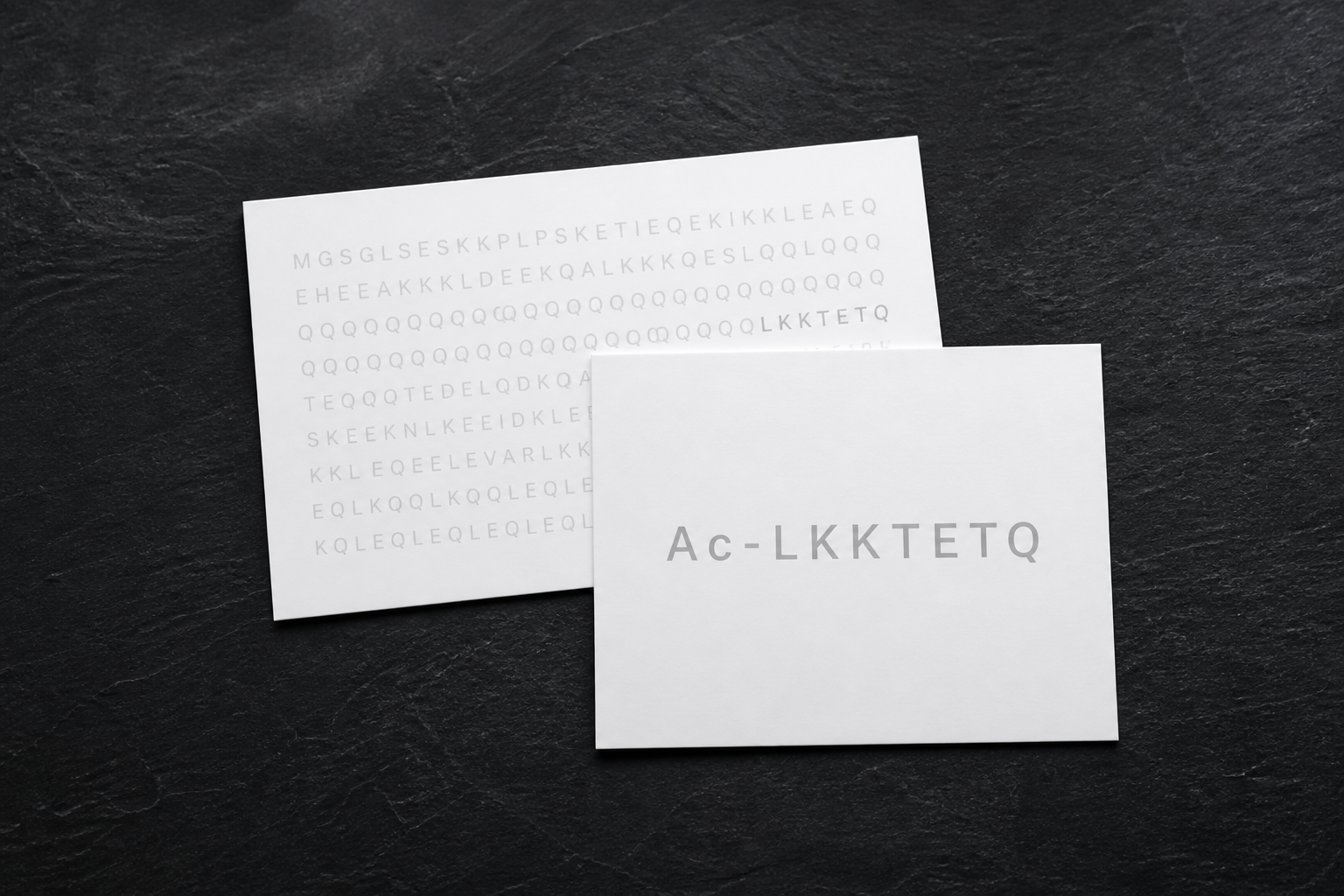
In the analytical literature, TB-500 is not full-length thymosin β4. Esposito, Deventer, and colleagues identified the material sold as TB-500 as the N-terminal acetylated 17–23 fragment of thymosin β4: Ac-LKKTETQ (Esposito et al., Drug Test Anal, 2012, PMID 22962027). That distinction matters for identity work. Catalog lots labeled TB-500 should be read against that heptapeptide, not against the 43-residue parent.
Sequence and chemical identity
Low, Hu, and Goldstein reported the complete amino acid sequence of bovine thymosin β4 in 1981, a 43-residue polypeptide whose central stretch includes LKKTETQ (Low et al., Proc Natl Acad Sci USA, 1981, PMID 6940133). Van Troys, Dewitte, Goethals, Carlier, and Vandekerckhove later mapped the actin-binding site of thymosin β4 by mutational analysis and located that function on the LKKTETQ motif (Van Troys et al., EMBO J, 1996, PMID 8617195). Safer, Elzinga, and Nachmias had already shown that thymosin β4 and the actin-sequestering peptide Fx are the same molecule in biochemical assays (Safer et al., J Biol Chem, 1991, PMID 1999398).
Esposito et al. synthesized the acetylated 17–23 fragment, characterized it, and matched it to TB-500 as then encountered in the marketplace. The sequence they report is Ac-Leu-Lys-Lys-Thr-Glu-Thr-Gln. That is a different chemical entity from intact thymosin β4 and from the N-terminal tetrapeptide Ac-SDKP, which is a cleavage product of the parent protein, not TB-500 itself.
A 2023 chemistry paper on products labeled TB500/TB1000 compared declared sequences with what the authors actually measured in commercial materials (Delcourt et al., Drug Test Anal, 2023, PMID 36482504). For a laboratory, the lesson is ordinary: identity is an analytical result, not a label claim. Lot identity and purity belong on the certificate of analysis for that batch. See the COA library for current documentation.
LC-MS methods in the literature
Literature context — not product use. The findings below are those of the cited authors in their experimental systems. Axovera Labs does not manufacture, market, or sell products for diagnosis, treatment, cure, prevention, or any human or veterinary application.
Ho, Kwok, Lau, Wong, and colleagues published an LC-MS method for TB-500 in equine urine and plasma, describing the analyte as a synthetic version of an active region of thymosin β4 (Ho et al., J Chromatogr A, 2012, PMID 23084823). The matrices are animal fluids used for doping-control method development. The paper is useful because it specifies chromatography and mass-spectrometric detection of the fragment, not because of any catalog use. Axovera materials are not for animal or human application.
Industry context
FDA’s page on bulk drug substances that may present significant safety risks lists “Thymosin beta-4, fragment (LKKTETQ), also known as TB-500” among withdrawn Category 2 nominations for compounding (FDA, compounding safety-risk substances). That listing concerns human-drug compounding. Axovera Labs does not compound TB-500 as a 503A drug product. The catalog listing is a research material for laboratory work.
What this means for a research catalog
Taken together, the papers above support a narrow set of laboratory facts: literature TB-500 is discussed as the acetylated Tβ4 17–23 fragment Ac-LKKTETQ; that motif sits inside the 43-residue thymosin β4 sequence and is the actin-binding site those authors mapped; LC-MS methods exist for the fragment in defined matrices; and commercial labels are not a substitute for lot analytics. They do not support a use, a protocol, or a human or veterinary application of any Axovera product.
Axovera Labs supplies TB-500 as a research material. See the TB-500 catalog listing for identity, size, and current documentation. Not for human or veterinary use.
The statements and information in this article have not been evaluated by the U.S. Food and Drug Administration. Products offered by Axovera Labs are intended strictly for laboratory research purposes only and are not intended to diagnose, treat, cure, or prevent any disease or medical condition. All products are supplied exclusively for in vitro and preclinical research applications and are not for human or veterinary use.