TLDR
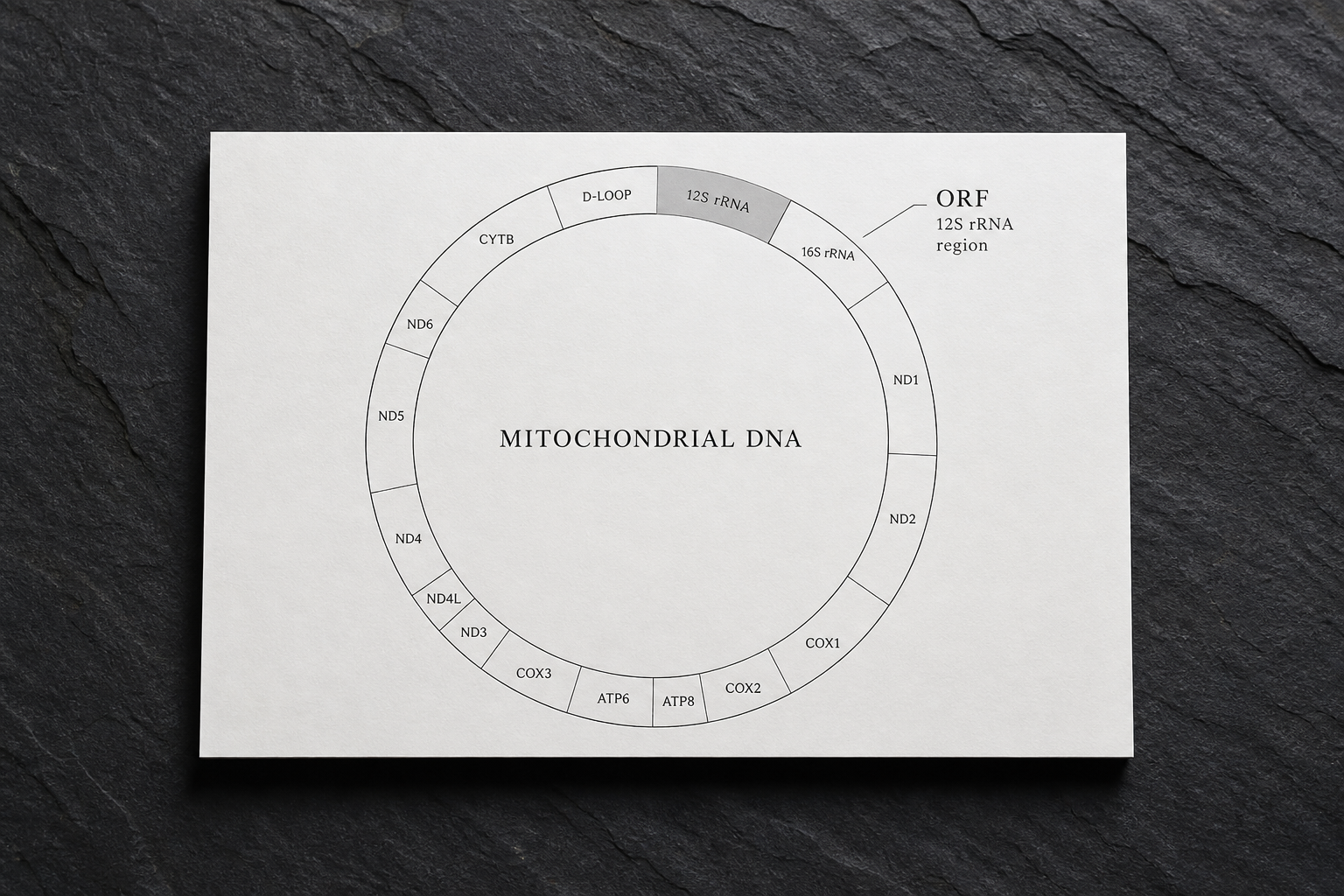
MOTS-c is a 16-residue peptide encoded by a short open reading frame in mitochondrial 12S rRNA. This post covers that sequence assignment, published variants (K14Q, Y8F), and cell models in the literature. Catalog lots are research material and are not for human or veterinary use.
This article summarizes published scientific literature for laboratory-research context only. It is not medical advice, not a use protocol, and not a claim of safety or effectiveness in humans or animals. Axovera Labs products are sold strictly for in vitro and preclinical research and are not for human or veterinary use.
MOTS-c is discussed as a 16-residue peptide encoded by a short open reading frame in mitochondrial 12S rRNA. Lee, Zeng, Drew, and colleagues named that peptide and reported its sequence in a 2015 Cell Metabolism paper that combined cell assays with mouse experiments (Lee et al., Cell Metab, 2015, PMID 25738459). For a laboratory, the identity claim is the 16-amino-acid assignment. Axovera Labs catalog items are research materials, not drugs, and are not for human or veterinary use.
Sequence and variants
Lee et al. assign MOTS-c as a 16-mer from the 12S rRNA sORF. Zempo, Kim, Fuku, and colleagues later described the mtDNA polymorphism m.1382A>C (rs111033358), which substitutes glutamine for lysine at position 14 of that 16-residue peptide (K14Q), and compared wild-type and K14Q peptides in vitro (Zempo et al., Aging, 2021, PMID 33468709). García-Benlloch and colleagues mapped a putative motif in the YIFY stretch and tested a Y8F sequence mutant in C2C12 and LHCN-M2 myotube cultures (García-Benlloch et al., Peptides, 2022, PMID 35842023). Those are sequence facts. They are not a labeled use.
Lot identity and purity belong on the certificate of analysis for that batch. See the COA library for current documentation.
Cell models
Kim, Son, Benayoun, and Lee reported that MOTS-c translocates to the nucleus under metabolic stress in cultured cells, with AMPK dependence and interaction at antioxidant-response elements (Kim et al., Cell Metab, 2018, PMID 29983246). Bień, Pruszyńska-Oszmałek, Kołodziejski, and colleagues studied MOTS-c in INS-1E (β) and αTC-1 (α) cultures, reporting secretion, viability, apoptosis, and peptide-output readouts under glucose or free-fatty-acid conditions they defined (Bień et al., Histochem Cell Biol, 2024, PMID 38430258). The 2022 Peptides paper is likewise an in-vitro differentiation assay in myotube lines.
Literature context — not product use. The findings below are those of the cited authors in their experimental systems. Axovera Labs does not manufacture, market, or sell products for diagnosis, treatment, cure, prevention, or any human or veterinary application.
Preclinical arms in the discovery paper
The 2015 Lee paper and the 2021 Zempo paper include mouse assays and, in Zempo, human cohort genetics around the K14Q substitution. Metabolic endpoints in those arms are observations of those authors in those models. Amounts, routes, and schedules in those methods sections are facts of the cited studies. They are not directions for Axovera catalog items, which are not for animal or human use.
What this means for a research catalog
Taken together, the papers above support a narrow set of laboratory facts: MOTS-c is discussed as a 16-residue mitochondrial sORF peptide; K14Q and Y8F are published sequence variants; and cell systems in the literature include nuclear-translocation assays, pancreatic α/β lines, and myotube cultures. They do not support a use, a protocol, or a human or veterinary application of any Axovera product.
Axovera Labs supplies MOTS-C as a research material. See the MOTS-C catalog listing for identity, size, and current documentation. Not for human or veterinary use.
The statements and information in this article have not been evaluated by the U.S. Food and Drug Administration. Products offered by Axovera Labs are intended strictly for laboratory research purposes only and are not intended to diagnose, treat, cure, or prevent any disease or medical condition. All products are supplied exclusively for in vitro and preclinical research applications and are not for human or veterinary use.