TLDR
LL-37 is a 37-residue human cathelicidin peptide, LLGDFFRKSKEKIGKEFKRIVQRIKDFLRNLVPRTES, with a calculated mass near 4493 Da. This post covers how that sequence is processed from hCAP-18, how reviews classify antimicrobial peptides (AMPs), and how identity is checked by HPLC and mass spectrometry. A different AMP-class tripeptide in the same literature, KPV, is one component of the KLOW research blend. Axovera Labs supplies research materials, not products for human or veterinary use.
This article summarizes published scientific literature for laboratory-research context only. It is not medical advice, not a use protocol, and not a claim of safety or effectiveness in humans or animals. Axovera Labs products are sold strictly for in vitro and preclinical research and are not for human or veterinary use.
Antimicrobial peptides are a chemical class: short, usually cationic chains that laboratories study as membrane-active molecules. LL-37 is the mature C-terminal fragment of the only human cathelicidin, hCAP-18. For a laboratory that needs to know what a 37-mer is, the useful facts are residue string, precursor processing, helix-in-lipid structure, and how authors confirm mass. A separate, much shorter sequence that shows up in AMP papers is KPV. Those are the questions this review answers. Axovera Labs catalog items are research materials, not drugs, and are not for human or veterinary use.
Sequence and chemical identity
Agerberth and colleagues first described a cysteine-free human peptide they called FALL-39, encoded in bone marrow and testis (Agerberth et al., Proc Natl Acad Sci USA, 1995, PMID 7529412). Gudmundsson, Agerberth, and co-workers then showed that the mature granulocyte peptide is two residues shorter and named it LL-37 for the N-terminal leucine–leucine motif (Gudmundsson et al., Eur J Biochem, 1996, PMID 8681941). That 37-mer is the identity most analytical and structural papers assume.
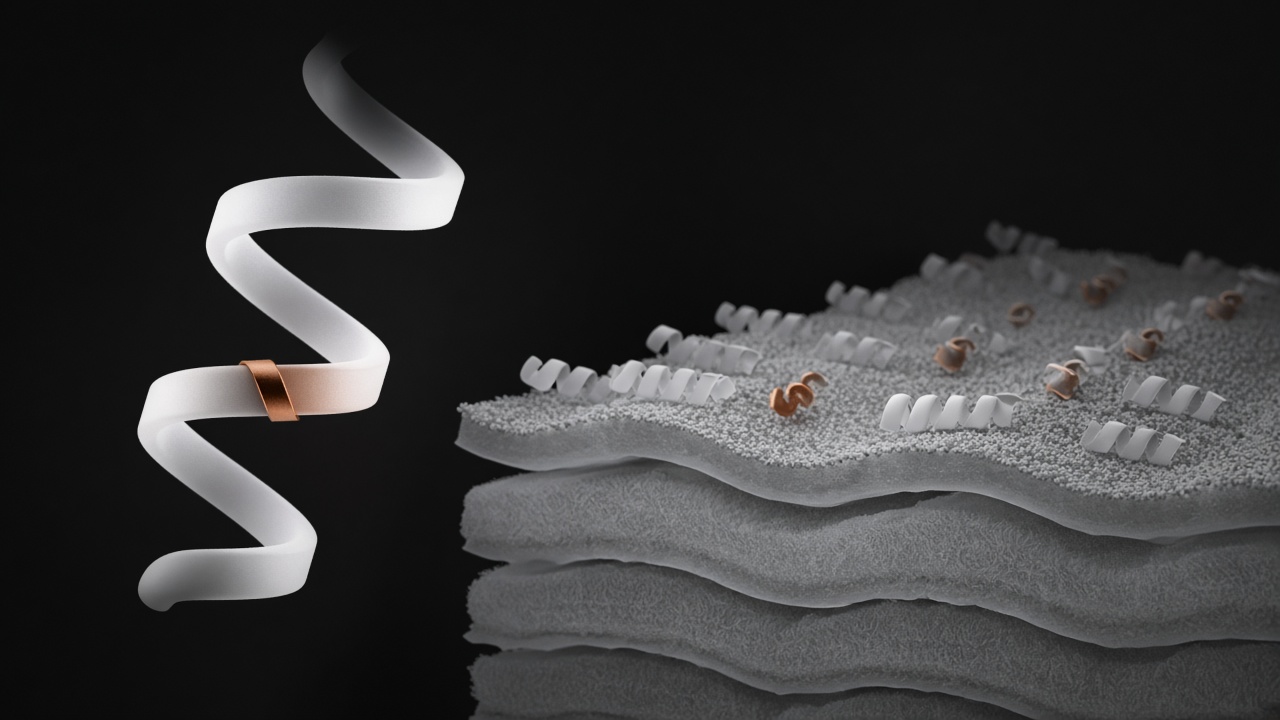
The precursor is hCAP-18, a cathelin-family protein of neutrophil specific granules (Cowland, Johnsen, and Borregaard, FEBS Lett, 1995, PMID 7615076). Sørensen et al. reported extracellular cleavage of hCAP-18 by proteinase 3 to release LL-37 (Sørensen et al., Blood, 2001, PMID 11389039). UniProt lists the mature peptide as CAMP / P49913 residues corresponding to that C-terminal 37-mer. Approximate molecular weight in catalog-style documentation is 4493.3 Da; the molecular formula commonly listed for the free peptide is C205H340N60O53. Those numbers describe a chemical entity. They do not describe a labeled use.
Moon, Henzler-Wildman, and Ramamoorthy expressed a GST–LL-37 fusion in E. coli, cleaved it, purified the 37-mer by reverse-phase HPLC on a C18 column, and confirmed identity by MALDI-TOF: observed [M+H]+ 4492.4 Da versus calculated 4493.3 Da (Moon et al., Biochim Biophys Acta, 2006, PMID 16542635). That is an identity workflow — chromatography plus intact mass — not a specification for any Axovera lot. Lot identity and purity belong on the certificate of analysis for that batch.
How reviews classify AMPs
Huan, Kong, Mou, and Yi surveyed the field in Frontiers in Microbiology in 2020, citing 3,240 entries in the APD3 database as of 24 August 2020. They report typical AMP length of 10–60 residues (mean 33.26) and a mean net charge of +3.32, with a minority of anionic sequences (Huan et al., Front Microbiol, 2020, PMID 33178164; PMC7596191).
They classify AMPs four ways:
| Axis | What authors put in the bin | LL-37’s place in that bin |
|---|---|---|
| Source | Mammal, amphibian, insect, microbe, plant, marine | Mammalian cathelicidin (human CAMP / hCAP-18) |
| Reported activity class | Antibacterial, antifungal, antiviral, antiparasitic, and other database tags | Linear α-helical host-defense peptide; reviews also list other activity tags in APD3 |
| Structure | α-helix, β-sheet / disulfide, extended, mixed | Amphipathic α-helix in lipid environments (PDB 2K6O in their Figure 5) |
| Residue bias | Pro-, Trp/Arg-, His-, or Gly-rich subclasses | Cationic, amphipathic 37-mer; no disulfide bonds |
That table is taxonomy. It is not a claim that any catalog item is an antibiotic, a drug, or a treatment.
Huan et al. also separate membrane models (barrel-stave, toroidal pore, carpet) from intracellular targets (ribosomes, nucleic acids, proteases). They assign LL-37 to the carpet model: peptides accumulate parallel to the bilayer and disrupt it in a detergent-like way once a local concentration threshold is reached. That assignment is the authors’ reading of the membrane-biophysics literature. It is not a use instruction.
Helix, fragments, and membrane chemistry
Johansson, Gudmundsson, Rottenberg, Berndt, and Agerberth reported that antibacterial readings for LL-37 in their assays tracked helix content: the peptide was disordered in aqueous buffer and adopted α-helix in membrane-mimetic solvent, with salt and pH changing both conformation and measured activity (Johansson et al., J Biol Chem, 1998, PMID 9452503). That paper is conformation chemistry in defined media. It is not a protocol for a research catalog.
Oren, Lerman, Gudmundsson, Agerberth, and Shai mapped LL-37 in phospholipid membranes by spectroscopy and related oligomerization to how the peptide sits in the bilayer (Oren et al., Biochem J, 1999, PMID 10417311). Wang later solved NMR structures of full-length LL-37 and of KR-12 (residues 18–29, KRIVQRIKDFLR) in lipid micelles, describing KR-12 as the smallest antimicrobial fragment in that series (Wang, J Biol Chem, 2008, PMID 18818205). Fragment names (KR-12, FK-13, GF-17, and others) are sequence coordinates. They are not additional catalog SKUs.
Literature context — not product use. The findings below are those of the cited authors in their experimental systems. Axovera Labs does not manufacture, market, or sell products for diagnosis, treatment, cure, prevention, or any human or veterinary application.
Huan et al. also review design levers used in AMP papers — chain length, net charge, hydrophobicity, amphipathicity, D-amino acids, cyclization, lipidation — and environmental variables that change readings in vitro (salt, divalent cations, pH, proteases). Those are physical-chemistry constraints on a cationic helix, not directions for compounding or administration. The same review notes that as of 2020 only a small set of peptide antibiotics (they name gramicidin, daptomycin, and colistin among FDA-approved examples) sat in that regulated-drug bucket. LL-37 is not an FDA-approved drug.
KPV: a different AMP-class sequence
LL-37 is not in the Axovera catalog. A different short sequence that AMP papers treat as a host-defense peptide is KPV — lysine–proline–valine, the C-terminal tripeptide of α-MSH (α-melanocyte-stimulating hormone). Cutuli, Cristiani, Lipton, and Catania reported antimicrobial readings for α-MSH peptides, including KPV, in their in vitro systems (Cutuli et al., J Leukoc Biol, 2000, PMID 10670585). Catania and colleagues framed the same motif in a host-defense review the same year (Catania et al., Ann N Y Acad Sci, 2000, PMID 11268348).
That is class adjacency, not homology. KPV is three residues, formula C16H30N4O4, mass about 342.4 Da. LL-37 is a 37-residue cathelicidin helix. They do not share a precursor, a fold, or a fragment map. Putting them in one article is a literature grouping (short cationic peptides discussed as AMPs), not a claim that one substitutes for the other.
In the catalog, KPV appears only as one component of the KLOW research blend (BPC-157 10 mg, TB-500 10 mg, GHK-Cu 50 mg, KPV 10 mg; 80 mg total lyophilized powder). That listing is a laboratory material. It is not a use of LL-37, not a use of KPV, and not for human or veterinary use.
What this means for a research catalog
Taken together, the papers above support a narrow set of laboratory facts: LL-37 is discussed as the 37-residue sequence LLGDFFRKSKEKIGKEFKRIVQRIKDFLRNLVPRTES, processed from hCAP-18; it is an amphipathic α-helix in lipid environments; HPLC plus intact MS can confirm mass near 4493 Da; and AMP reviews place it among linear cathelicidins in the carpet-model class. A separate AMP-class tripeptide in that literature is KPV, which is one component of KLOW. None of that supports a use, a protocol, or a human or veterinary application of any Axovera product.
Axovera Labs does not list LL-37 as a standalone SKU. See the shop for current research-compound listings and documentation. Not for human or veterinary use.
The statements and information in this article have not been evaluated by the U.S. Food and Drug Administration. Products offered by Axovera Labs are intended strictly for laboratory research purposes only and are not intended to diagnose, treat, cure, or prevent any disease or medical condition. All products are supplied exclusively for in vitro and preclinical research applications and are not for human or veterinary use.