TLDR
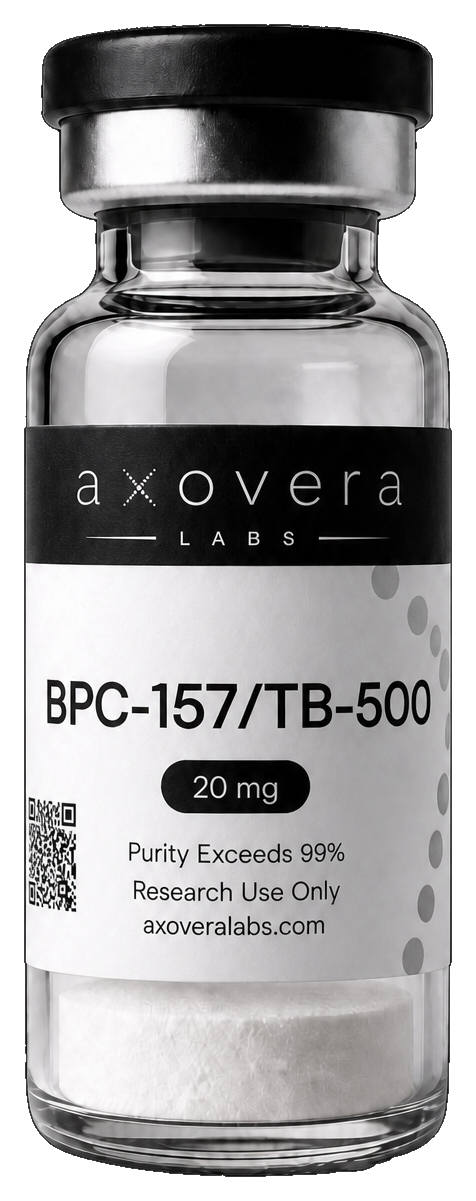
BPC-157 is a 15-residue peptide, GEPPPGKPADDAGLV, with a mass near 1419. This post covers LC-MS identity methods, published experimental models, and 503A compounding context. Axovera Labs supplies it as a research material, not for human or veterinary use.
This article summarizes published scientific literature for laboratory-research context only. It is not medical advice, not a use protocol, and not a claim of safety or effectiveness in humans or animals. Axovera Labs products are sold strictly for in vitro and preclinical research and are not for human or veterinary use.
BPC-157 appears in the literature as a synthetic pentadecapeptide — 15 amino acids — most often described as a fragment related to a larger gastric “body protection compound.” For a laboratory that needs to know what is in a vial, the useful facts are chemical identity, how authors detect that identity, and which experimental systems the papers actually used. Those are the three questions this review answers. Axovera Labs catalog items are research materials, not drugs, and are not for human or veterinary use.
Sequence and chemical identity
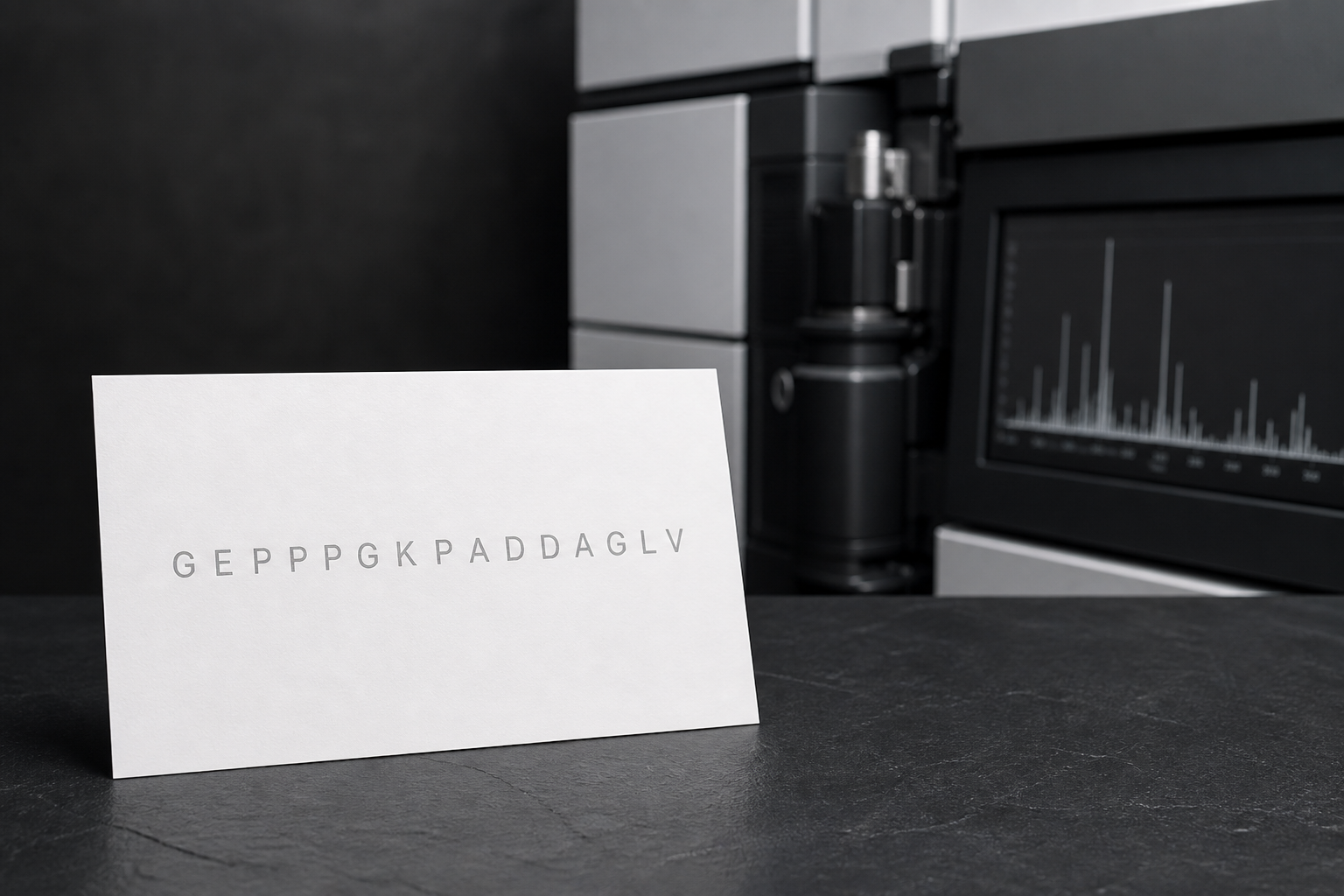
Two independent papers print the same residue string. Cox, Miller, and Eichner, writing in Drug Testing and Analysis in 2017, identify BPC 157 as GEPPPGKPADDAGLV after analyzing confiscated vials and building a urine LC-MS method (Cox et al., Drug Test Anal, 2017, PMID 28035768). Staresinic and colleagues, in the Journal of Orthopaedic Research in 2003, report the same sequence and a molecular weight of 1419 (Staresinic et al., J Orthop Res, 2003, PMID 14554208).
That 15-mer is the identity most analytical papers assume. Approximate molecular weight in catalog documentation is 1419.5 g/mol, consistent with the 1419 figure in the 2003 paper. The molecular formula commonly listed for the free peptide is C62H98N16O22. Those numbers describe a chemical entity. They do not describe a labeled use.
Chang, Tsai, Hsu, and Pang later write the same 15 residues in long form (Gly-Glu-Pro-Pro-Pro-Gly-Lys-Pro-Ala-Asp-Asp-Ala-Gly-Leu-Val) in an open-access Molecules paper on cultured rat Achilles tendon fibroblasts (Chang et al., Molecules, 2014, PMID 25415472). Sequence strings in HTML can pick up extra residues in some renderings; the three papers above agree on a 15-residue peptide. That is the string to use for identity work.
LC-MS and UHPLC-HRMS methods in the literature
Identity in a research setting is an analytical problem: can the intact peptide, and characteristic fragments, be measured against a reference?
Cox et al. validated a weak-cation-exchange solid-phase extraction method coupled to LC-MS for BPC 157 in urine, with a reported limit of detection of 0.1 ng/mL, precision under 20%, and r2 of 0.998. They also ran in vitro plasma incubations and reported a stable metabolite alongside the parent peptide. In their hands, the parent peptide remained detectable in urine for at least four days under the conditions they tested. That work is doping-control method development. It is useful to a laboratory because it specifies extraction chemistry, a detection limit, and a metabolite to watch — not because of any catalog use.
Tian and colleagues (2023) took a different analytical route: stable-isotope labeling (13C/15N) plus UHPLC-HRMS to map an in vitro metabolic profile (Tian et al., Molecules, 2023, PMID 37959764). They describe a workflow for picking isotope m/z pairs, report nine metabolites across two incubation models (one via a less conventional path, eight via amide-bond cleavage), and validate detection of the parent peptide plus five main metabolites in human urine with limits of detection in the 0.01–0.11 ng/mL range. Again, the paper’s purpose is anti-doping method development. For a research lab, the takeaway is that BPC-157 is analytically tractable by high-resolution LC-MS and that amide-bond fragments are the metabolites those authors observed in vitro.
Neither paper is a specification for an Axovera lot. Lot identity and purity belong on the certificate of analysis for that batch. See the COA library for current documentation.
Literature context — not product use. The findings below are those of the cited authors in their experimental systems. Axovera Labs does not manufacture, market, or sell products for diagnosis, treatment, cure, prevention, or any human or veterinary application.
Published experimental models
A large share of BPC-157 papers use rodent tissue or cultured fibroblasts. Those systems are not product uses. They are the models the authors chose. What follows is what those papers reported, attributed to them.
Chang, Tsai, Lin, Hsu, and Pang cultured rat Achilles tendon explants and isolated tendon fibroblasts (Chang et al., J Appl Physiol, 2011, PMID 21030672). They reported faster explant outgrowth in the presence of BPC 157, no direct increase in fibroblast proliferation by MTT, higher cell survival under hydrogen-peroxide stress, increased transwell migration, faster spreading on culture dishes, and F-actin changes with FAK/paxillin signaling. That is a cell-culture and explant paper. It does not describe a use of Axovera materials.
The 2014 Chang Molecules paper, using tendon fibroblasts from male Sprague-Dawley rat Achilles tendon, reported growth-hormone receptor as a highly up-regulated transcript on microarray, then confirmed higher GHR mRNA and protein by RT-PCR and Western blot in a concentration- and time-dependent manner in culture. When those authors added growth hormone to BPC 157-exposed fibroblasts, they reported higher MTT readings, PCNA expression, and time-dependent JAK2 activation. The experimental system is isolated rat fibroblasts plus recombinant growth hormone in vitro.
Staresinic et al. used a rat Achilles-transection model (a 5 mm proximal cut, leaving a gap between cut ends) and, separately, cultured tendocytes versus 4-hydroxynonenal. In the animal arm they reported higher load to failure, load to failure per area, Young’s modulus, and Achilles functional index versus saline, with microscopical differences in mononuclear and granulocyte counts over 14 days. Routes, schedules, and amounts in that paper are facts of that study’s methods. They are not directions for Axovera catalog items, which are not for animal or human use.
He, Feng, Guo, Zhou, and colleagues published pharmacokinetics, distribution, metabolism, and excretion of BPC157 in rats and beagle dogs after single intravenous and intramuscular administration, including a radiolabeled [3H]BPC157 ADME arm (He et al., Front Pharmacol, 2022, PMID 36588717). They reported an elimination half-life of the prototype peptide under 30 minutes, linear pharmacokinetics across the doses they tested, mean absolute bioavailability after intramuscular administration of roughly 14–19% in rats and 45–51% in dogs, and excretion mainly via urine and bile, with rapid breakdown into small peptide fragments and amino acids. The paper also notes a prior solid-phase synthesis process used by that group. This is animal PK. It is not a protocol for a research catalog, and Axovera products are not for that application.
503A compounding context
BPC-157 is not an FDA-approved drug, is not the subject of a USP or NF monograph as an approved finished drug, and does not appear on the 503A bulk-substances list. In a 1 April 2020 warning letter to Tailor Made Compounding LLC, FDA listed BPC 157 among bulk substances used to compound products that, in the agency’s view, were not eligible for 503A exemptions — because they lacked an applicable USP/NF monograph, were not a component of an FDA-approved human drug, and were not on the 503A bulks list (FDA warning letter, Case 594743).
That letter is about compounding drug products for human use. Axovera Labs does not compound BPC-157 as a 503A drug product. The catalog listing is a research material for laboratory work. The distinction is the entire compliance posture: research-use-only distribution is not compounding, and it is not an approved drug application.
What this means for a research catalog
Taken together, the papers above support a narrow set of laboratory facts: BPC-157 is discussed as the 15-residue sequence GEPPPGKPADDAGLV with a mass near 1419; LC-MS and UHPLC-HRMS methods exist for the parent peptide and amide-bond fragments; and published experimental systems include rat tendon explants, cultured fibroblasts, a rat Achilles-transection model, and rat/dog PK. They do not support a use, a protocol, or a human or veterinary application of any Axovera product.
Axovera Labs supplies BPC-157 as a research material. See the BPC-157 catalog listing for identity, size, and current documentation. Not for human or veterinary use.
The statements and information in this article have not been evaluated by the U.S. Food and Drug Administration. Products offered by Axovera Labs are intended strictly for laboratory research purposes only and are not intended to diagnose, treat, cure, or prevent any disease or medical condition. All products are supplied exclusively for in vitro and preclinical research applications and are not for human or veterinary use.