TLDR
NAD+ is the oxidized pyridine nucleotide cofactor. This post covers identity (anomer and redox state), HPLC and LC-MS methods for NAD+/NADH, and in-vitro enzyme assays that use NAD+ as a substrate. Catalog items are research material and are not for human or veterinary use.
This article summarizes published scientific literature for laboratory-research context only. It is not medical advice, not a use protocol, and not a claim of safety or effectiveness in humans or animals. Axovera Labs products are sold strictly for in vitro and preclinical research and are not for human or veterinary use.
NAD+ (nicotinamide adenine dinucleotide, oxidized) is a pyridine nucleotide cofactor. For a laboratory that needs to know what is in a vial, the useful facts are chemical identity, how authors separate NAD+ from NADH and related species, and which extraction or enzyme assays those papers used. This review stays on that analytical ground. It is not a supplementation note. Axovera Labs catalog items are research materials, not drugs, and are not for human or veterinary use.
Identity of the cofactor
Klemm, Steiner, Cumme, and Horn characterized α-NADH as a distinct anomer, with purification and spectroscopic criteria that separate it from the β form used in most dehydrogenase assays (Klemm et al., Anal Biochem, 1993, PMID 8214579). Identity work on NAD/NADH starts with that kind of isomer question: which anomer, which redox state, and whether the sample has degraded on the column.
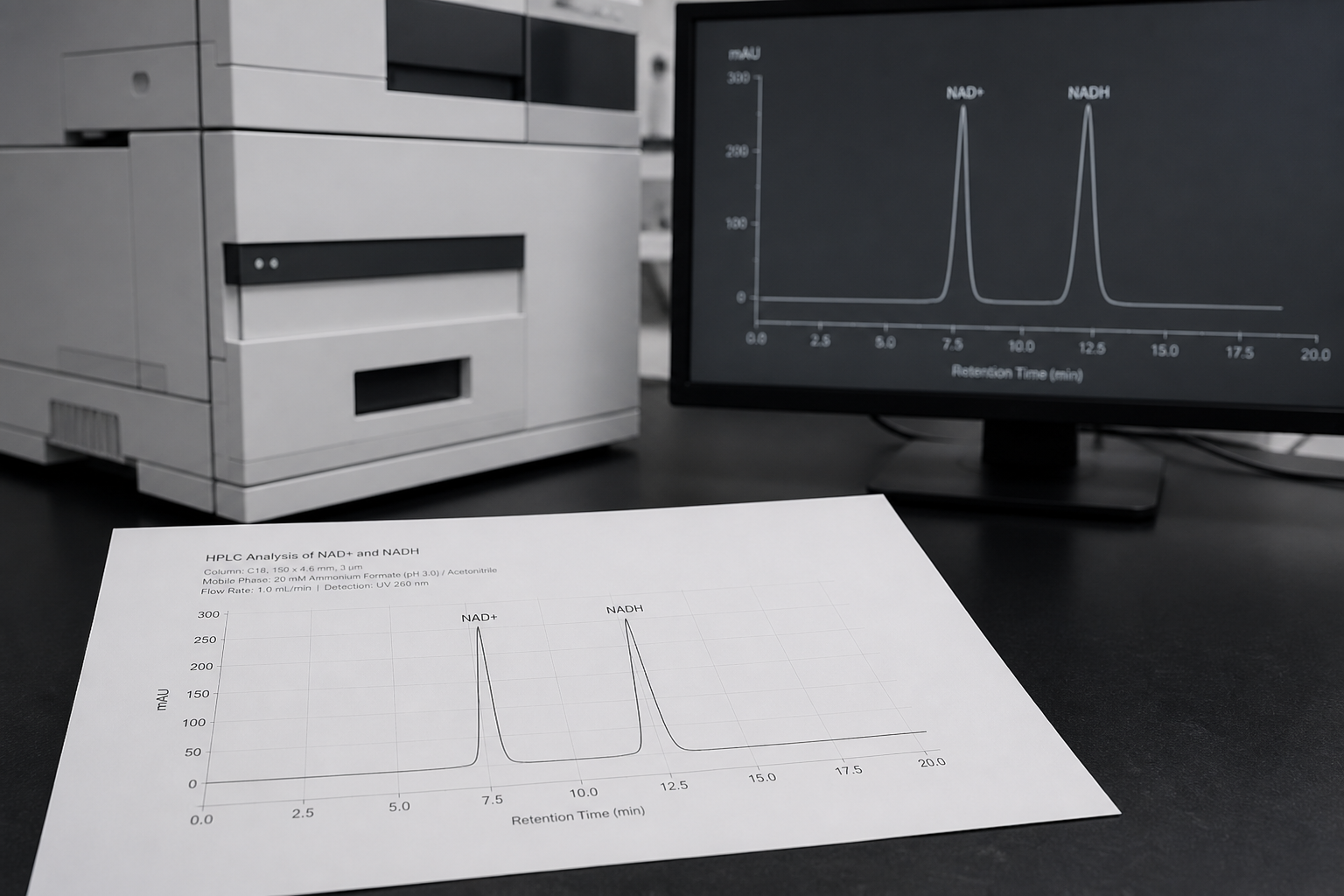
Miksic and Brown used reversed-phase and anion-exchange HPLC in complementary modes to study reduced nicotinamide adenine dinucleotide, including chromatographic behavior that matters when NADH is the analyte (Miksic and Brown, J Chromatogr, 1977, PMID 21194). Those are chemistry papers about the analyte, not about a catalog use.
HPLC and LC-MS methods
Sporty, Kabir, Turteltaub, and Ognibene described a single-sample extraction protocol for quantifying NAD and NADH redox states in Saccharomyces cerevisiae, then measured those states by HPLC (Sporty et al., J Sep Sci, 2008, PMID 18763242). The model is yeast. The contribution is extraction plus chromatography of the redox pair.
Bustamante, Jayasena, Richani, Gilchrist, and colleagues published a tandem LC-MS approach for quantifying the cellular NAD+ metabolome, covering NAD+ and related pyridine nucleotides in cell extracts (Bustamante et al., Metabolomics, 2017, PMID 30830318). Røst, Shafaei, Fuchino, and Bruheim reported zwitterionic HILIC tandem mass spectrometry with isotope dilution for pyridine nucleotides in biological extracts, including NAD+ and NADH-class species (Røst et al., J Chromatogr B, 2020, PMID 32222674).
Those methods papers specify columns, transitions, and extraction choices. They are not specifications for an Axovera lot. Lot identity and purity belong on the certificate of analysis. See the COA library for current documentation.
In-vitro enzyme use of NAD+ as a substrate
Cirilli, Amici, Gilley, Coleman, and colleagues adapted a commercial NAD+ quantification kit to assay the base-exchange activity and substrate preferences of SARM1 in a defined in-vitro system (Cirilli et al., Molecules, 2024, PMID 38398599). NAD+ in that paper is an enzyme substrate on the bench. That is characterization chemistry. It is not a use of Axovera catalog items in any organism.
Industry context
FDA has reminded compounders that food-grade NAD+ is not suitable for sterile compounding (FDA compounding reminder). Nicotinamide adenine dinucleotide also appears among substances nominated for the 503A bulks list; nomination is not approval. Axovera Labs does not compound NAD+ as a 503A drug product. The catalog listing is a research material for laboratory work.
What this means for a research catalog
Taken together, the papers above support a narrow set of laboratory facts: NAD+ is the oxidized pyridine nucleotide cofactor; anomeric and redox-state questions are part of identity; HPLC and LC-MS/MS methods exist for NAD+/NADH and related metabolites in yeast and cell extracts; and NAD+ is used as a substrate in defined in-vitro enzyme assays. They do not support a use, a protocol, or a human or veterinary application of any Axovera product.
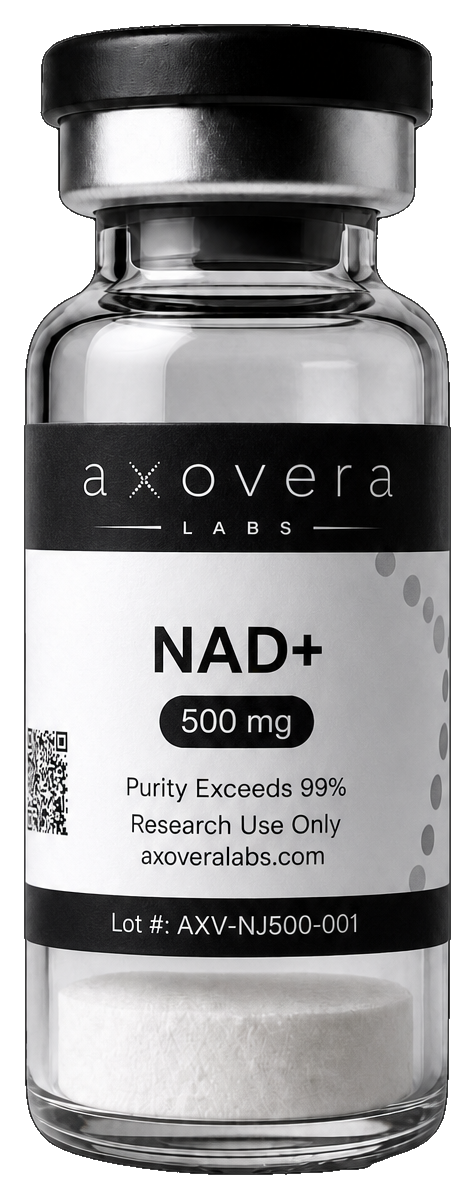
Axovera Labs supplies NAD+ as a research material. See the NAD+ catalog listing for identity, size, and current documentation. Not for human or veterinary use.
The statements and information in this article have not been evaluated by the U.S. Food and Drug Administration. Products offered by Axovera Labs are intended strictly for laboratory research purposes only and are not intended to diagnose, treat, cure, or prevent any disease or medical condition. All products are supplied exclusively for in vitro and preclinical research applications and are not for human or veterinary use.