TLDR
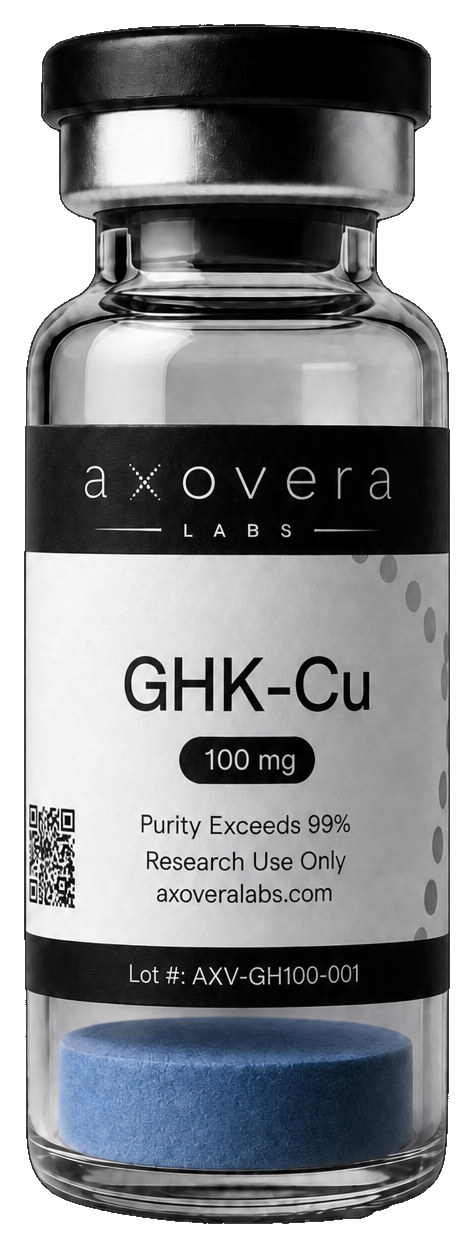
GHK-Cu is the copper(II) complex of the tripeptide Gly-His-Lys. This post covers isolation, coordination chemistry, and the cell-culture systems those papers used. Axovera Labs supplies GHK-Cu as a research material, not for human or veterinary use.
This article summarizes published scientific literature for laboratory-research context only. It is not medical advice, not a use protocol, and not a claim of safety or effectiveness in humans or animals. Axovera Labs products are sold strictly for in vitro and preclinical research and are not for human or veterinary use.
GHK-Cu in the literature is the copper(II) complex of the tripeptide glycyl-L-histidyl-L-lysine. The free peptide is Gly-His-Lys. The useful laboratory questions are sequence, how copper is coordinated, and which cell-culture or chemical systems the papers actually used. Axovera Labs catalog items are research materials, not drugs, and are not for human or veterinary use.
Sequence and isolation
Pickart and Thaler isolated a serum tripeptide that they studied on cultured liver cells (Pickart and Thaler, Nat New Biol, 1973, PMID 4349963). A later paper from the same line of work names the growth-modulating tripeptide as glycylhistidyllysine, reports association with copper and iron in plasma, and describes peptide–metal complexes in hepatoma cell culture (Pickart and Thaler, J Cell Physiol, 1980, PMID 6246126). Those are isolation and culture papers. They describe a chemical entity recovered from plasma and tested in vitro. They are not a labeled use of any catalog material.
Copper coordination chemistry
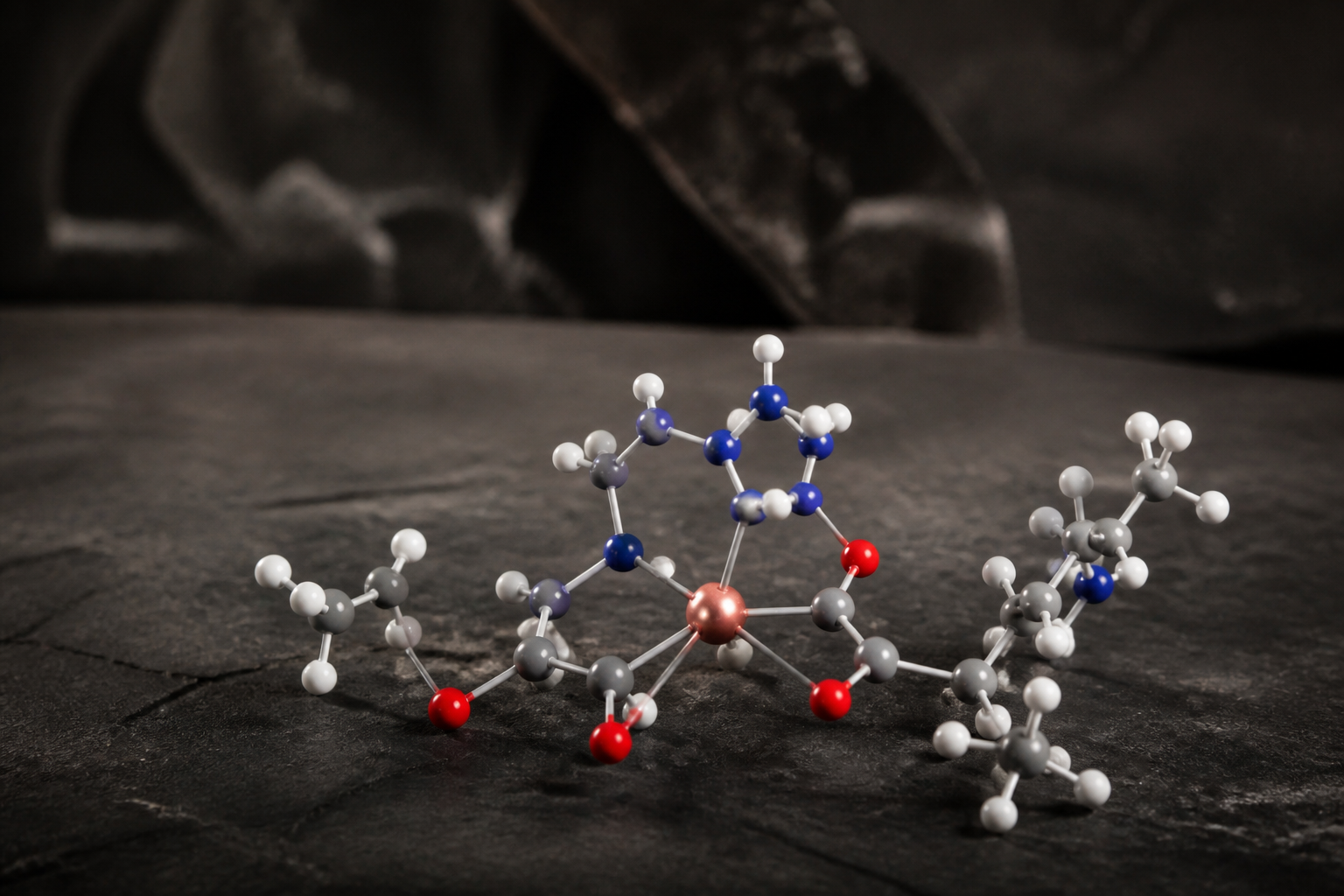
Lau and Sarkar studied the interaction of copper(II) with glycyl-L-histidyl-L-lysine by potentiometry and visible spectroscopy, including ternary species with histidine and competition with albumin (Lau and Sarkar, Biochem J, 1981, PMID 7340824). Freedman, Pickart, Weinstein, Mims, and Peisach reported the solution structure of the Gly-His-Lys–copper(II) complex by optical, EPR, and ESEEM methods: a 1:1 mononuclear complex at neutral pH, with the histidine imidazole nitrogen in the equatorial set, and a solution structure distinct from the solid-state polymer (Freedman et al., Biochemistry, 1982, PMID 6291585).
Hureau and colleagues later compared X-ray and solution structures of Cu(II)–GHK and Cu(II)–DAHK complexes and discussed redox properties. In their hands the GHK complex is dimeric in the crystal and monomeric in solution, with NH2, amidyl, and imidazole ligands plus a labile oxygen site (Hureau et al., Chemistry, 2011, PMID 21780203). Conato, Gavioli, Guerrini, Kozlowski, and colleagues characterized copper complexes of GHK and two synthetic analogues by potentiometry, calorimetry, UV-Vis, CD, and EPR, and also reported enzymatic stability in human serum and an in-vitro growth-factor assay (Conato et al., Biochim Biophys Acta, 2001, PMID 11325542).
Those papers are coordination chemistry. They tell a laboratory how authors described the Cu(II) ligand set. They are not specifications for an Axovera lot. Lot identity belongs on the certificate of analysis. See the COA library for current documentation.
Literature context — not product use. The findings below are those of the cited authors in their experimental systems. Axovera Labs does not manufacture, market, or sell products for diagnosis, treatment, cure, prevention, or any human or veterinary application.
Cell-culture systems in the cited papers
The 1973 and 1980 Pickart papers use cultured liver and hepatoma cells. The 2001 analogue paper includes an in-vitro growth-factor assay and human-serum stability measurements. Those experimental systems are facts of the papers. Amounts, media, and incubation times in those methods sections are not directions for Axovera catalog items, which are not for human or veterinary use.
What this means for a research catalog
Taken together, the papers above support a narrow set of laboratory facts: GHK is the tripeptide Gly-His-Lys; GHK-Cu is discussed as a Cu(II) complex whose solution coordination involves the N-terminus, a peptide amide, and the histidine imidazole; and published systems include potentiometry, EPR/ESEEM, X-ray versus solution structures, and defined cell-culture assays. They do not support a use, a protocol, or a human or veterinary application of any Axovera product.
Axovera Labs supplies GHK-Cu as a research material. See the GHK-Cu catalog listing for identity, size, and current documentation. Not for human or veterinary use.
The statements and information in this article have not been evaluated by the U.S. Food and Drug Administration. Products offered by Axovera Labs are intended strictly for laboratory research purposes only and are not intended to diagnose, treat, cure, or prevent any disease or medical condition. All products are supplied exclusively for in vitro and preclinical research applications and are not for human or veterinary use.